

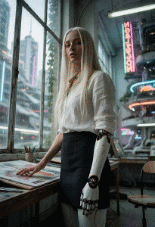
In three years, AI image generation has moved from technical curiosity to production tool. Video, long confined to research labs and studios with serious budgets, is now following the same path. Between online platforms, open source models and desktop applications, the landscape has grown rich enough that knowing where to start has become a genuine problem. This article takes stock of the available technologies, what they actually allow you to do, and the criteria that should guide your choice of tool.
Image and video: two very different levels of maturity
Image generation has reached a quality level where results are often indistinguishable from photography. Current diffusion models handle anatomy, hands, textures and lighting with a reliability that was far from guaranteed two years ago. Text rendered inside images, long the Achilles heel of these systems, has also become legible.
Video sits roughly where images did in 2023: impressive on short sequences, typically five to ten seconds, but temporal consistency remains the central challenge. A character has to keep the same face, the same clothes and the same build from one shot to the next, which requires far more than a sequence of independently generated frames.
Recent engines have made real progress here. Some now handle lip sync, audio generation and camera movement in a single pass, which brings the exercise closer to actual staging than to rough animation.
The core problem: character consistency
This is the wall every user hits after the first few experiments. Generating a good-looking image is no longer difficult. Generating the same person across ten different scenes is another matter entirely.
The technical answer has a name: LoRA, for Low-Rank Adaptation. It is a small file, a few megabytes, that adjusts the behaviour of an existing model without retraining it from scratch. In practice, you supply fifteen to thirty images of the same face, training takes a few minutes, and the resulting file lets you recall that face in any subsequent generation.
Result quality depends less on the number of images than on their variety. Too few images and the model memorises the background instead of the face. Images that are too similar and it locks onto one specific pose or lighting setup. The goal is to teach it what stays constant in that face regardless of angle or light.
The same principle applies to locations. It becomes possible to lock a setting, an interior or an environment and reuse it across generations, which opens the door to genuinely coherent visual series.
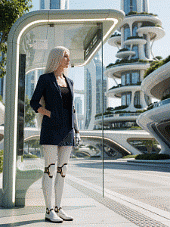
Cloud or local: the decision that shapes everything else
The most consequential choice remains infrastructure. Two approaches coexist, with very concrete implications.
Online platforms require no particular hardware. A browser is enough, compute is pooled, and updates are seamless. In exchange, the business model almost always rests on subscriptions or credit packs, with every generation deducted from a balance. Files pass through third-party servers, which raises the question of how that data is handled, particularly when training a model on photographs of real people. Finally, the platform’s content policies apply, with restrictions that are sometimes hard to anticipate.
Local generation requires a decent graphics card, in practice an NVIDIA GPU with at least eight gigabytes of video memory. In return, compute costs nothing beyond electricity, generation volume is unlimited, and files never leave the machine. That last point matters especially when training a model on faces, since the training images stay entirely under the user’s control.
The most practical compromise combines both: handle the repetitive, high-volume work locally, and reach for the cloud occasionally for the heaviest jobs, such as certain video generations that demand more power than an ordinary workstation can deliver.

The interface barrier
The open source image generation ecosystem largely runs on node-graph tools. Their flexibility is real, and they remain the reference for prototyping a pipeline. But they assume you understand the underlying model architecture, can wire processing steps together manually, and are willing to manage dependencies yourself.
That technical barrier explains why many users fall back on online platforms even though their hardware would let them generate locally. The challenge for a new generation of applications is therefore to keep the power of open source engines while removing their operational complexity.
This is precisely the approach taken by tendre.AI, a Windows application that wraps a local generation engine behind a conventional interface. Character training takes a single click, camera movements are offered as presets, and image retouching works by describing the change in plain language rather than painting masks. The software runs on the user’s GPU, with the option to switch to the cloud for the most demanding jobs, and is sold as a one-time license rather than a subscription.
Beyond generation: narrative uses
A notable development of recent months is the convergence of visual generation and conversational interaction. Language models can bring characters to life who hold a conversation, while diffusion models give them a consistent face.
Combining the two opens uses that neither allowed on its own: narrative experiences where the user creates their own character and moves through a story alongside AI-driven non-player characters, with scenes you see as much as read. Text-based roleplay, which has existed for decades, gains a coherent visual dimension.
How to choose in practice
A handful of questions settle the matter quickly:
- What is your generation volume? Occasional use fits an online platform perfectly well. Regular production makes a hardware investment pay for itself quickly.
- Are you working with faces? If you train models from photographs of real people, where that data is processed becomes a central question.
- Do you need consistency? A one-off visual requires no particular tooling. A coherent series demands a character training system.
- What is your technical level? Node-based tools offer maximum control, integrated applications prioritise speed of execution.
- What hardware do you have? Without a dedicated GPU, the local option is off the table.

What comes next
Three trends stand out clearly. The first is longer generated video sequences, with consistency maintained well beyond the ten-second mark. The second is the unification of modalities: image, video, sound and dialogue produced by a single system rather than a chain of separate tools. The third is the continued democratisation of open models, whose performance closes in on proprietary solutions year after year, with the advantage of running on consumer hardware.
For users, this mainly means one thing: the question is no longer whether convincing images or videos can be generated, but which tool’s design matches your use case, your hardware and your requirements around data.