

Introduction
Pyrolytic Boron Nitride offers exceptional thermal and chemical properties, but its layered microstructure presents unique machining challenges.
Traditional mechanical machining — milling, drilling, turning — can induce edge chipping, delamination, and surface damage. As component geometries become more complex, manufacturers increasingly turn to laser micromachining to achieve the precision their applications demand.
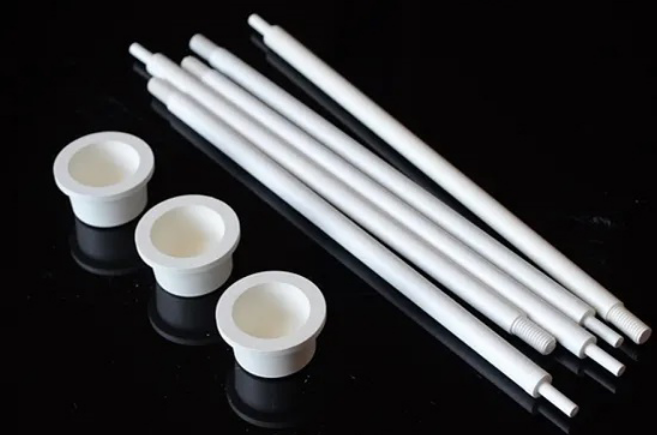
Stanford Advanced Materials (SAM) offers precision laser-machined PBN components for the most demanding applications.
Why PBN Is Difficult to Machine Mechanically
PBN’s hexagonal crystal structure is highly anisotropic. The basal planes exhibit weak van der Waals bonding, which gives PBN its characteristic easy cleavage along the deposition plane.
When mechanical tools engage the material:
- Edge chipping — layers peel away at cut edges
- Delamination — subsurface separation of layers
- Stress concentrations — microcracks that propagate during thermal cycling
- Surface roughness — inconsistent finish
Tight-tolerance components for semiconductor and evaporation applications cannot tolerate these defects.
The Laser Solution
CO₂ lasers operating at 9.3–10.6 µm wavelength are particularly effective for machining PBN. The laser energy is absorbed by the material, generating localized heating that vaporizes the PBN without mechanical contact.
Advantages of Laser Micromachining
Non-Contact Processing — No tool wear, no mechanical stress, no tool-induced defects.
High Precision — Kerf widths as small as 50 µm can be achieved.
Complex Geometries — Holes, slots, and intricate profiles are possible.
Minimal Thermal Damage — Low heat-affected zone with proper parameter selection.
Clean Cuts — No edge chipping or delamination when parameters are optimized.
Limitations to Consider
- Heat input — Excessive power can cause local graphitization
- Thickness limitations — Very thick sections may require multiple passes
- Surface finish — May require additional finishing for some applications
Applications Requiring Precision PBN
Thin-Wall Crucibles
For effusion cells and small-scale crystal growth, crucible wall thickness may be 2–3 mm or less. Achieving uniform thickness and precise internal dimensions often requires laser machining.
Complex Heater Elements
Filament rings and intricate heater geometries for MBE and OLED systems demand precise slot patterns and hole placements that are difficult to achieve mechanically.
Custom Machined Parts
Many OEMs require custom PBN components to integrate with specific equipment. Laser machining enables production of these parts without the tooling costs of mechanical methods.
PBN Sheets with Precision Holes
Thermal shields and insulation components often require arrays of precisely positioned holes for gas flow or mounting. Laser drilling delivers these with consistent quality.
Process Optimization for PBN
Parameter Selection
Successful laser machining of PBN requires careful optimization of:
- Laser power — sufficient to vaporize without excessive energy input
- Pulse duration — short pulses minimize heat spread to surrounding material
- Gas assist — argon or nitrogen to clear debris and reduce oxidation
- Focus position — precise control for consistent kerf geometry
- Scan speed — balanced for throughput and quality
Quality Control Measures
- Dimensional inspection using CMM or vision systems
- Surface finish measurement
- Edge quality assessment under magnification
- Porosity and delamination inspection
Why Choose SAM for Precision PBN Components
Manufacturing Expertise — SAM combines CVD PBN production with in-house laser machining capability.
Design Support — Our engineering team assists with design optimization for manufacturability.
Quality Assurance — Every component is inspected to ensure it meets your specifications.
Competitive Lead Times — In-house machining eliminates third-party delays.
Custom Solutions — From prototypes to production volumes, we deliver precision components.
Conclusion
Laser micromachining has transformed what is possible with PBN components. Complex geometries, tight tolerances, and clean edges are now achievable — enabling new applications and improving performance in existing ones.
For manufacturers requiring precision PBN parts, SAM offers the combined capability of CVD production and laser machining under one roof.